
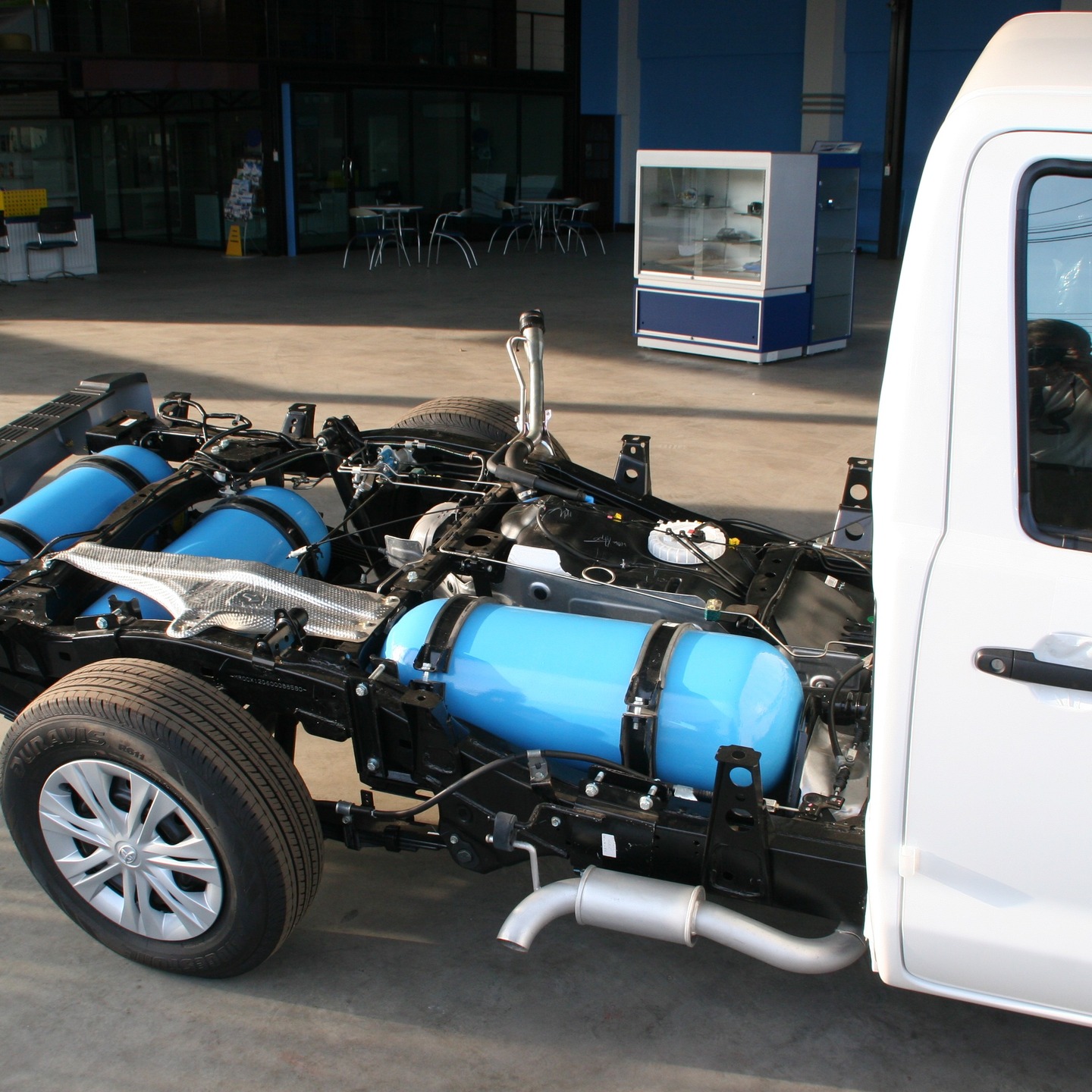
Vehicle Conversion to Biogas with ABG Cylinders
Biogas that has undergone cleaning and treatment processes can be used as an alternative fuel for certain vehicles. Biogas Nusantara provides vehicle conversion solutions that integrate gas processing, compression, and storage systems using ABG (Adsorbed Biogas) cylinders, allowing biogas to be stored and transported as a fuel source for transportation needs.
With the ABG system, biogas from sources such as livestock farms, agricultural operations, or waste treatment facilities can be processed and stored before being used as vehicle fuel. The system configuration is tailored to the vehicle type, engine characteristics, biogas quality, pressure requirements, storage capacity, and vehicle usage patterns.
This approach enables locally produced renewable energy sources to be integrated into a more flexible and decentralized transportation system.
The use of biogas for vehicles opens up opportunities for utilizing renewable energy derived from organic waste. Biogas that has undergone H₂S removal, moisture removal, filtration, and appropriate treatment can be further processed before being used as vehicle fuel.
By integrating ABG cleaning, compression, and storage, biogas does not have to be used directly at the production site. The gas can be processed and stored first, then transported to vehicles or points of use.
Key Benefits:
Renewable Fuel — utilizing biogas from organic sources as energy.
Waste to Energy — converting organic waste into a value-added energy source.
Flexible Storage — biogas can be stored using ABG cylinders.
Mobile Energy — fuel can be transported from the production source to the vehicle’s location.
Reducing Dependence on Fossil Fuels — has the potential to reduce fossil fuel use depending on vehicle configuration and feasibility.
ABG (Adsorbed Biogas) cylinders are used as part of biogas storage systems for transportation purposes.
Unlike conventional compressed gas storage, ABG technology uses a porous adsorbent material inside the cylinder. Methane (CH₄) molecules can be adsorbed onto the surface and within the micropores of this material, enabling gas storage with pressure and capacity characteristics tailored to the system’s design.
Each vehicle has different engine characteristics, fuel systems, and operational requirements. Therefore, the conversion system does not use a single, uniform configuration for all vehicles.
Configurations can be determined based on:
Vehicle type
Engine type and capacity
Vehicle fuel system
Biogas quality
Gas consumption rate
Required fuel pressure
Storage capacity
Vehicle usage patterns
Availability of biogas sources
Biogas Nusantara can help determine the appropriate system configuration based on vehicle requirements and project conditions.